
What are organizations for?
Organizations are shared workspaces where your team creates and manages spaces together.
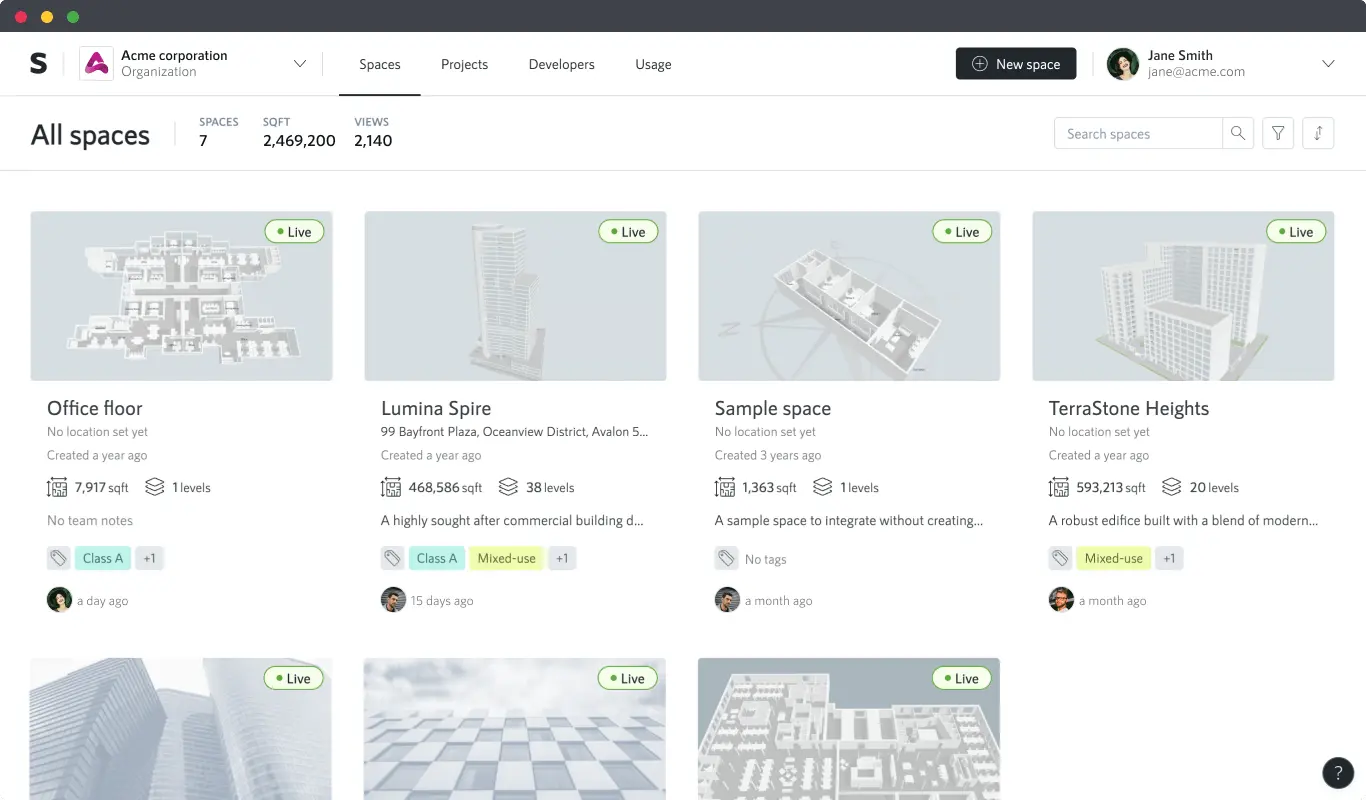
An organization is a shared workspace for your team's spaces. Every member can create, edit, and manage the organization's spaces, and one account can belong to several organizations. Each organization has its own members, settings, developer tokens and integration options, usage analytics, and connects to billing through a billing account.
What you can do with an organization
- Create and manage spaces together, with members able to create, edit, and monitor them
- Invite and manage members of the organization
- Group spaces into projects, with scoped access tokens and per-project analytics, available to every organization
- Use the organization's developers page for API tokens scoped to the organization
- Track usage in the Usage tab: total and billable views over time across the organization's spaces
Your free spaces
You get 3 free spaces to start, shared across all your organizations that aren't linked to a billing account. Once you've used them, set up a billing account, or link your organization to an existing one, to keep creating spaces. Organizations linked to a billing account have no space limit. For how billing works, see the billing articles in the help center.
How to switch between organizations
Click your organization's name and avatar in the top bar to open the organization switcher, then click the organization you want to work in. The one you're currently in is marked with a checkmark. Your personal spaces sit at the bottom of the same list, and you can also create a new organization from there.
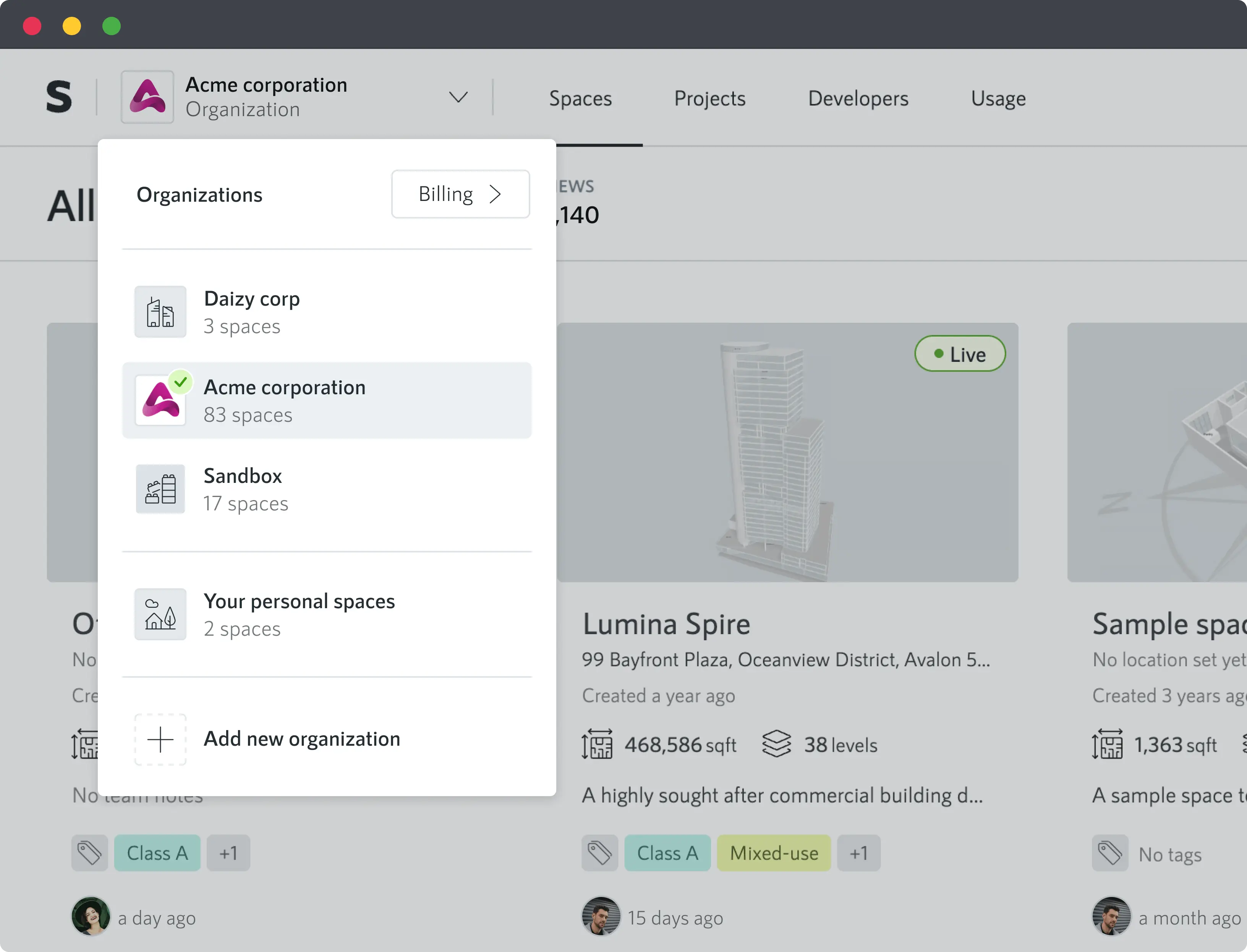
The switcher has two tabs:
- Organizations lists every organization you belong to, with its space count and a menu to jump to its people or settings.
- Billing shows every billing account you belong to and the organizations linked to each. This is also where you set up a billing account or link an organization to one.
Organizations and billing accounts
A billing account is the legal and payment entity your spaces are billed under. One billing account can cover several organizations with one consolidated invoice, whether that's a company with multiple business units or a team managing one organization per client. Linking an organization to a billing account removes the space limit for that organization. Read more in the billing accounts article.
Sandbox organizations
Every billing account can include one sandbox organization: a separate organization for development, testing, demos, and experiments, at no charge. Sandbox usage doesn't count toward your usage metrics, and spaces in a sandbox are watermarked, and not available for production use unless you transfer them to a billed organization. Read more in the sandbox organizations article.
Organizations and personal spaces
Alongside your organizations, your account has a personal spaces area: spaces that belong to you alone. The two are built for different things.
- Organizations are shared. Every member can see and work on the organization's spaces. Personal spaces are private: only you can access and manage them.
- Organizations can grow. Linked to a billing account, an organization has no spaces limit. Personal spaces are capped at 3, and that limit is separate from your organizations' free spaces.
- Organizations are where real work lives. They carry billing, projects, member management, and organization-scoped API tokens. Personal spaces are outside billing entirely: they're never billed and can't be linked to a billing account.
Use personal spaces to try things out on your own. For client work, production spaces, or anything you build with a team, use an organization. If a space outgrows your personal area, you can transfer it to any organization you're a member of.